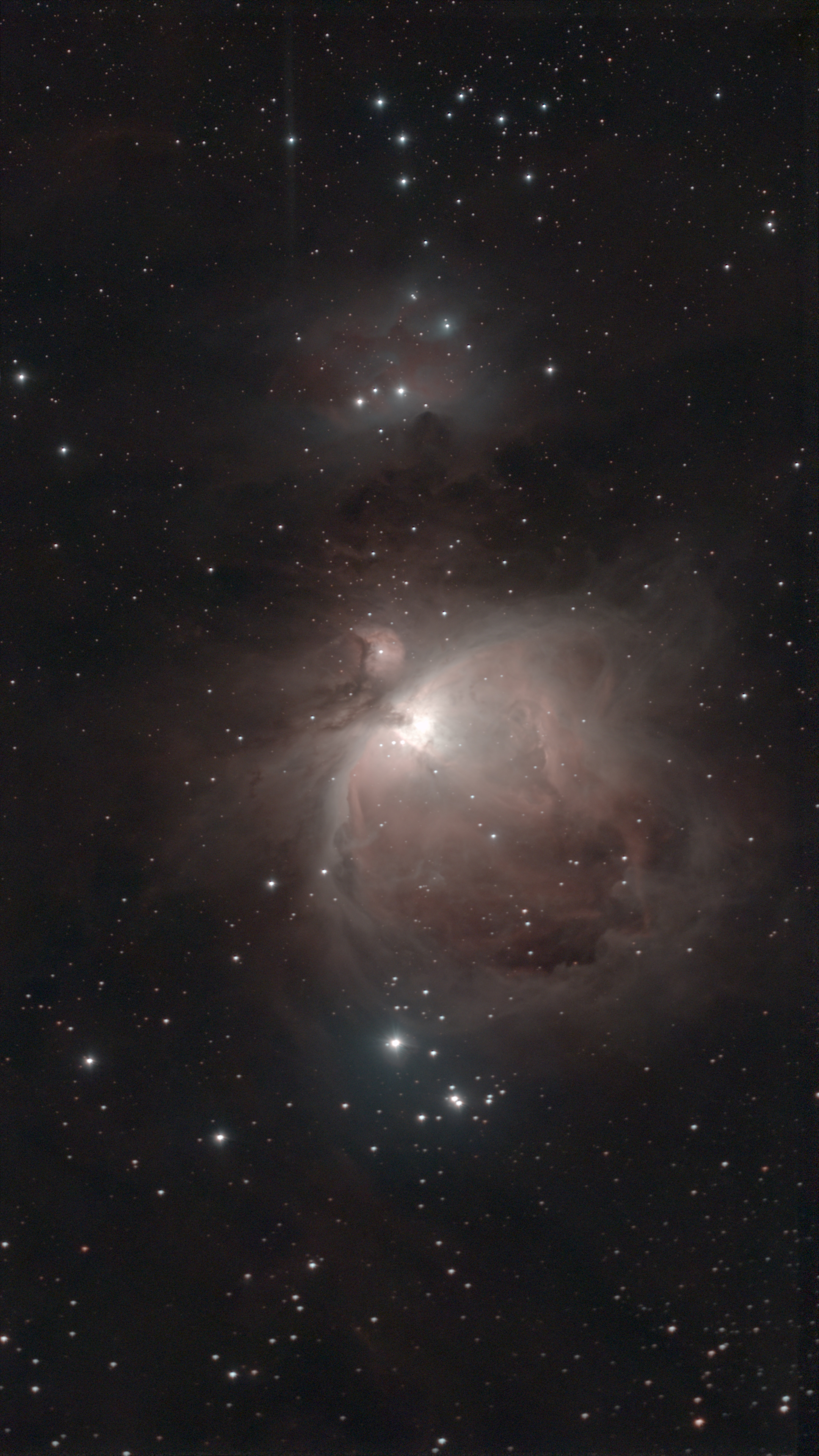
M42 — Orion Nebula
The great Orion Nebula, the brightest stellar nursery in the sky, visible to the naked eye below the hunter’s belt.
View photos ↓- Object type
- Emission and reflection nebula
- Constellation
- Orion
- Designation
- M42 (NGC 1976)
- Distance
- ≈ 1,340 light-years
- Apparent magnitude
- 4.0
- Apparent size
- 65 x 60 arcmin
- Best season
- Autumn / Winter (best visibility in Dec-Feb)
The Orion Nebula (M42) is the closest region of massive star formation to the Solar System. Visible to the naked eye as a fuzzy patch below the three stars of Orion’s belt, it is one of the most photographed deep-sky objects — and one of the most approachable for beginners.
At the heart of the nebula, the Trapezium cluster gathers a handful of young, very hot stars whose ultraviolet radiation ionizes the surrounding gas and sculpts the dust curls that show up in long exposures. The nebula also hosts numerous protoplanetary disks, planetary systems caught in the act of forming.
Its huge dynamic range is the main processing challenge: the core around the Trapezium saturates quickly while the outer extensions need exposure time. Combining short and long exposures is often necessary to render both at once.
Shot with the Seestar S50 Pro from the Ain, France, 215 exposures of 30 s stacked in Siril. The image was then reprocessed with Siril and AstroWizard, from the same exposures.