Gaming at 51: Survival, Factories and Problem Solving
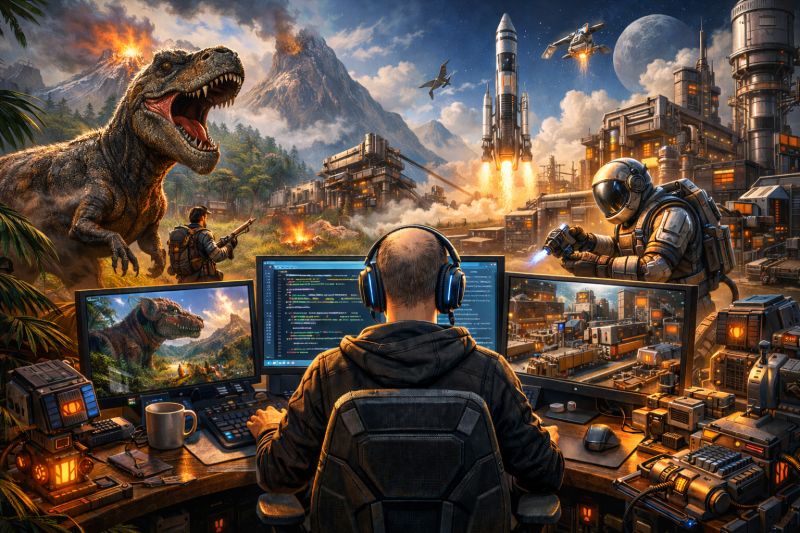
I play video games at 51. Some might say it’s not my age anymore. But I couldn’t care less.
I started on Game & Watch, Amstrad CPC, Atari (shoutout to the Amiga team 😉), then on consoles and PC. At first, gaming was simply a space to unwind and let go. But two categories eventually took centre stage in my life: survival games and factory games.
Sure, an FPS is a great way to blow off steam, and a sports game gave me some great moments with my son. But survival and factory games are something else entirely.
Survival games: observe, analyze, adapt
Survival demands that you discover mechanics, understand events, analyze them to react and find solutions. Shooting everything that moves is clearly not always the best option.
In Ark, you tame dinosaurs and use them according to their skills to progress. The further you go, the more you need to optimize resource production: craft better weapons, build a larger base. You can even breed dinos to optimize their stats across generations — all toward the ultimate goal of defeating the boss.
You test things out. Sometimes it works, sometimes it doesn’t. And when it fails, you have to understand why and try a different approach. No other choice.
Factory games: start from scratch, build systems
Factory games pose a different challenge. You start with nothing. To progress, you must learn new technologies (the recipes) and gather resources. The further you go, the greater the needs, and the more necessary it becomes to understand complex systems in order to engineer ever more powerful tools.
In Satisfactory, you begin with a simple pickaxe to extract a few ores. Then come the drills, conveyor belts to transport resources, then elaborate machines to produce parts needed for more productive miners. You start in a constrained environment, you learn, you seek solutions to be more productive and push further into the game.
Sometimes things break. A production chain stops, progression is blocked. You need to find where the bottleneck is: add a new production line, switch from load balancing to a manifold setup, or unclog an overloaded resource bus.
Gaming as a training ground
Isn’t this exactly the search for solutions through successive improvements, responding to a problem within a constrained environment?
What makes me thrive in my job — beyond sharing knowledge — is learning new technologies, mastering them, and using them to deliver the most effective solutions while accounting for real-world constraints and needs.
Gaming, in the end, is the same mental exercise. A playground where you unknowingly train yourself to analyze, iterate, and find elegant solutions to complex systems.
AI-generated image — because it’s trendy, and I didn’t feel like using a puppy photo 🦮